The Ultimate Guide to Padel: Rules, Equipment & Tactical Strategy
📑 Table of Contents: Complete Master Chapters
- Origins & The Global Racket Sport Revolution
- Court Architecture & Structural Geometry
- FIP Rules & Underhand Serve
- The Physics of Glass & Mesh Rebounds
- Racket Engineering: Shapes, Foam & Carbon
- The Tactical Shot Playbook & Biomechanics
- 2v2 Doubles Positioning & The Net War
- Technical Comparison: Padel vs Pickleball vs Tennis
- Footwear, Silica Sand & Injury Prevention
- Definitive Master FAQ
Chapter 1: Origins & The Global Racket Sport Revolution
Padel was born in 1969 in Acapulco, Mexico, when Mexican entrepreneur Enrique Corcuera adapted his home squash court by enclosing a 10m x 20m plot with 3-meter walls to prevent tennis balls from flying into his neighbor's lush garden vegetation. By introducing stringless wooden paddles and allowing the ball to be played off the enclosing walls, Corcuera inadvertently engineered what would become the world's most rapidly expanding racket sport.
Corcuera's Spanish friend, Prince Alfonso of Hohenlohe-Langenburg, fell in love with the game and introduced it to Marbella, Spain, in 1974. Over the ensuing decades, padel swept through Spain and Argentina, establishing itself as the second most popular participation sport after soccer. Today, under the governance of the International Padel Federation (FIP) and fueled by premier circuits like Premier Padel, the sport boasts over 30 million active players across 110+ countries, with massive growth accelerating through the United States, Europe, and the Middle East.
Unlike traditional tennis—which requires years of technical coaching to sustain enjoyable 10-shot rallies—padel provides an immediate positive feedback loop. Beginners can engage in thrilling, multi-shot exchanges within 15 minutes of picking up a racket, while the spatial complexity of the glass walls offers an infinitely high tactical ceiling for elite professionals.
Chapter 2: Court Architecture & Structural Geometry
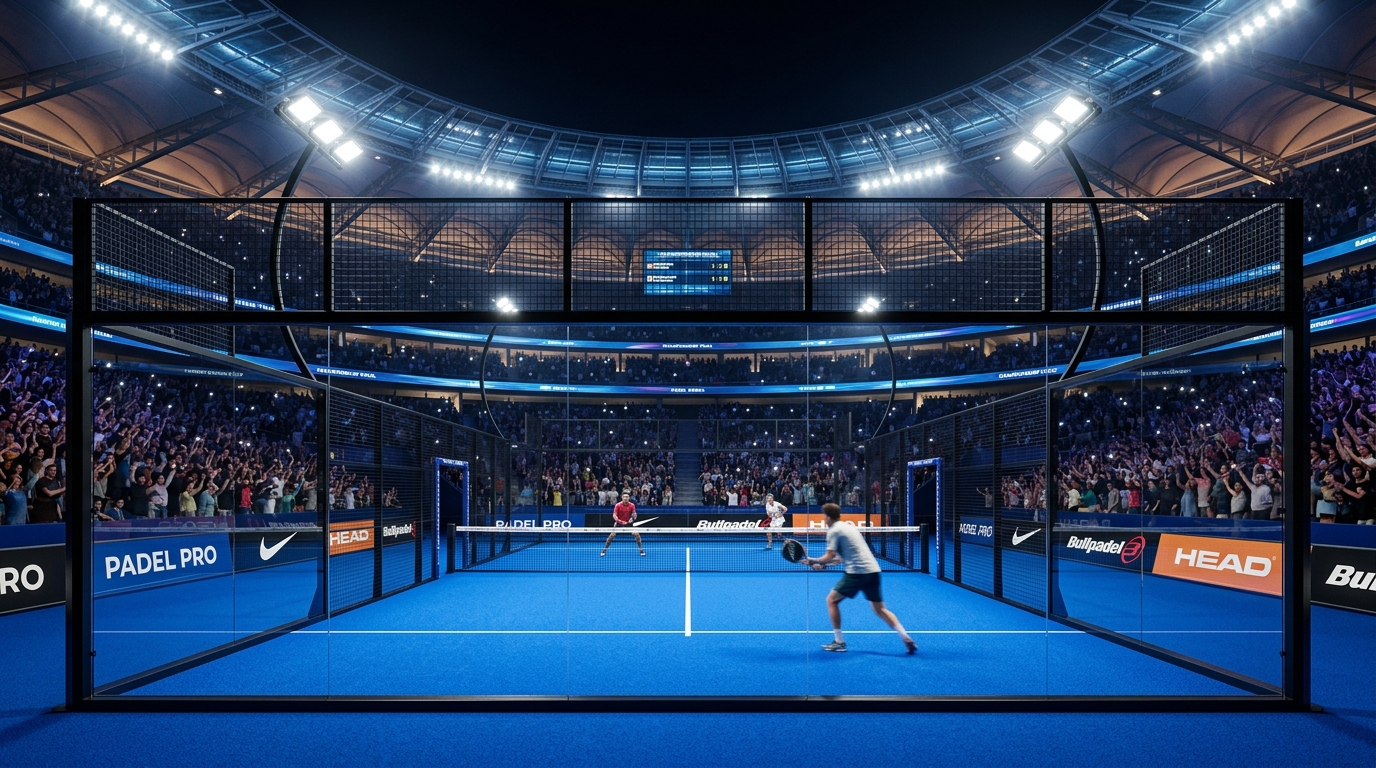
A regulation padel court is a meticulously engineered rectangular enclosure measuring exactly 10.00 meters wide by 20.00 meters long (32.8 ft x 65.6 ft), divided in half by a center net. The perimeter architecture consists of two distinct wall materials:
- Back Walls & Lateral Corners: Constructed from 10mm to 12mm thick structural tempered safety glass. The back wall stands 3 meters high (with an optional 1-meter metallic mesh extension reaching 4 meters total height).
- Side Walls (Lateral Panels): Feature a step-down combination of 3-meter high tempered glass extending 2 meters from the corners, followed by electro-welded metallic steel mesh panels (3m high near the back, stepping down to 2m or staying 3m in panoramic tournament designs).
- The Net: Suspended across the center line at a height of 88 cm (0.88m) at the midpoint, rising slightly to 92 cm (0.92m) at the structural posts.
- Playing Surface: Premium texturized monofilament or fibrillated artificial turf (12mm–15mm pile height) dressed with microscopic kiln-dried silica sand (0.2–0.6mm grain size) to ensure uniform rotational friction and ball bounce.
The service line is drawn exactly 3.00 meters away from the back glass wall. A central perpendicular dividing line splits the service area into two equal rectangles measuring 5.00m wide by 6.95m long.
Chapter 3: FIP Rules, Service & The Golden Point
Padel is fundamentally governed by the International Padel Federation (FIP). Below are the core regulatory rules every player must master:
3.1 The Underhand Serve Execution
Serving in padel is strictly an underhand motion. The server must stand behind the service line, bounce the ball on the turf behind the line, and strike the ball at or below waist height at impact. The serve must travel diagonally over the net into the opponent's opposite service box.
If the served ball bounces in the opponent's service box and subsequently touches the metallic side fence, it is an automatic fault. If it strikes the tempered glass wall after bouncing in the box, the serve is 100% legal and the returner must play it.
3.2 Rally Play & Floor Bounce Precedence
During active rallies, a ball struck over the net must hit the opponent's court floor before touching any enclosing back glass, side glass, or metallic fence. If an incoming ball strikes any wall directly on the full without bouncing on the floor first, the ball is out and the hitting team loses the point.
3.3 Scoring & The Golden Point (Punto de Oro)
Padel uses standard tennis scoring: 15, 30, 40, Game. Matches are played best-of-3 sets. Under the widely adopted Golden Point (Punto de Oro) rule, when the score reaches 40-40 (deuce), there is no advantage. Instead, a single sudden-death point is played where the receiving team chooses which player receives the serve.
Chapter 4: The Physics of Glass & Mesh Wall Rebounds
The walls of a padel court are not boundaries—they are dynamic playing surfaces. Mastering rebound angles separates club amateurs from championship players.
Back Glass Rebounds (Pared de Fondo)
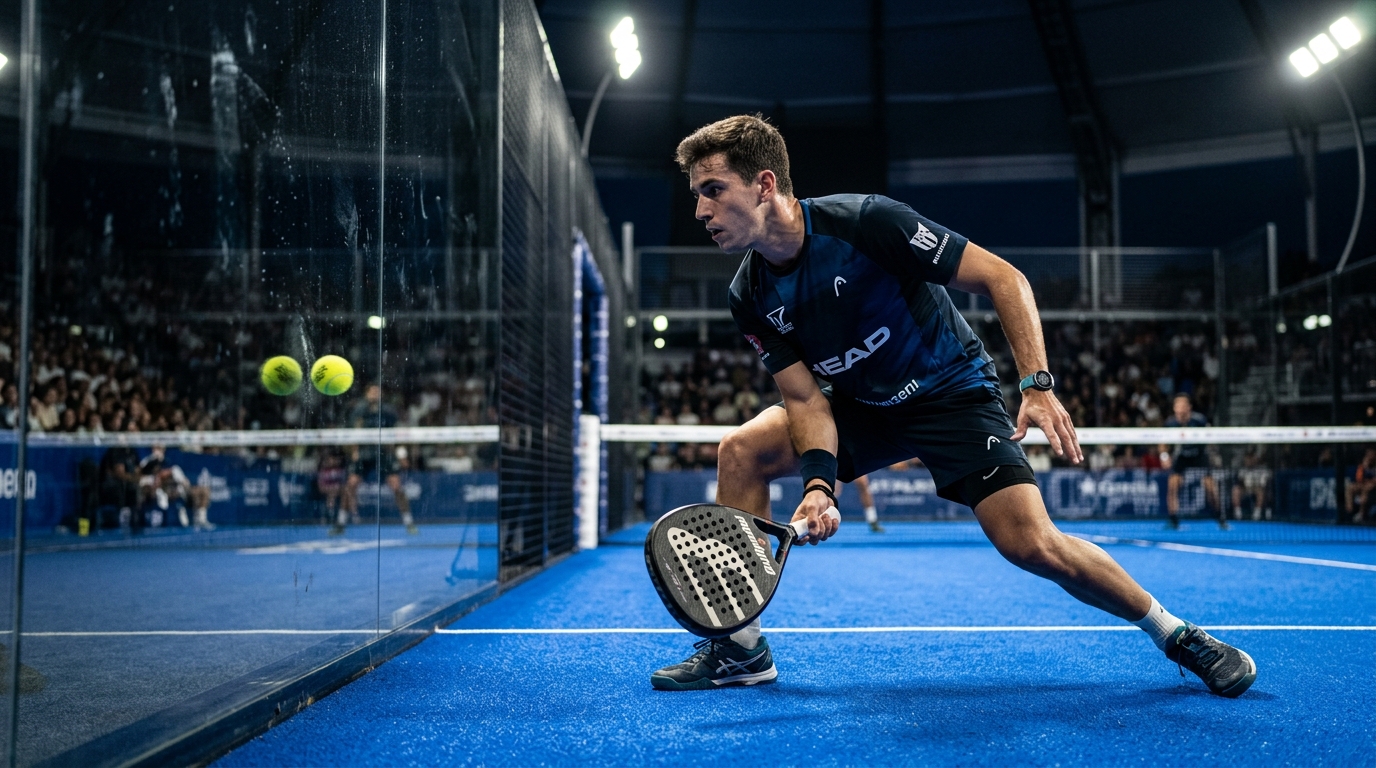
When an opponent drives a deep ball into the back glass, it compresses and rebounds forward. Beginners instinctually swing early at the baseline; advanced players step sideways, allow the ball to strike the glass, and strike it on the forward rebound as it decelerates.
Double Wall Corners (Doble Pared)
When a ball strikes the side glass and then the back glass (or vice versa), it performs a Doble Pared. Players must execute a circular footwork pivot to track the ball's rotational momentum and meet it in front of their body.
Hitting Off Your Own Glass (Autobajada / Salida de Pared)
If you are caught deep behind a ball close to the back glass with no room for a conventional forward stroke, you are legally permitted to hit the ball forcefully directly into your own back glass wall so that it vaults over the net into the opponent's court. (Note: You can never hit into your own metallic side fence).
Chapter 5: Racket Engineering: Shapes, Foam Cores & Carbon Weaves
A padel racket (known as a pala) is a stringless composite tool with a standardized maximum profile of 38mm thickness and a perforated surface. Understanding geometry and internal core density is critical to optimizing your performance:
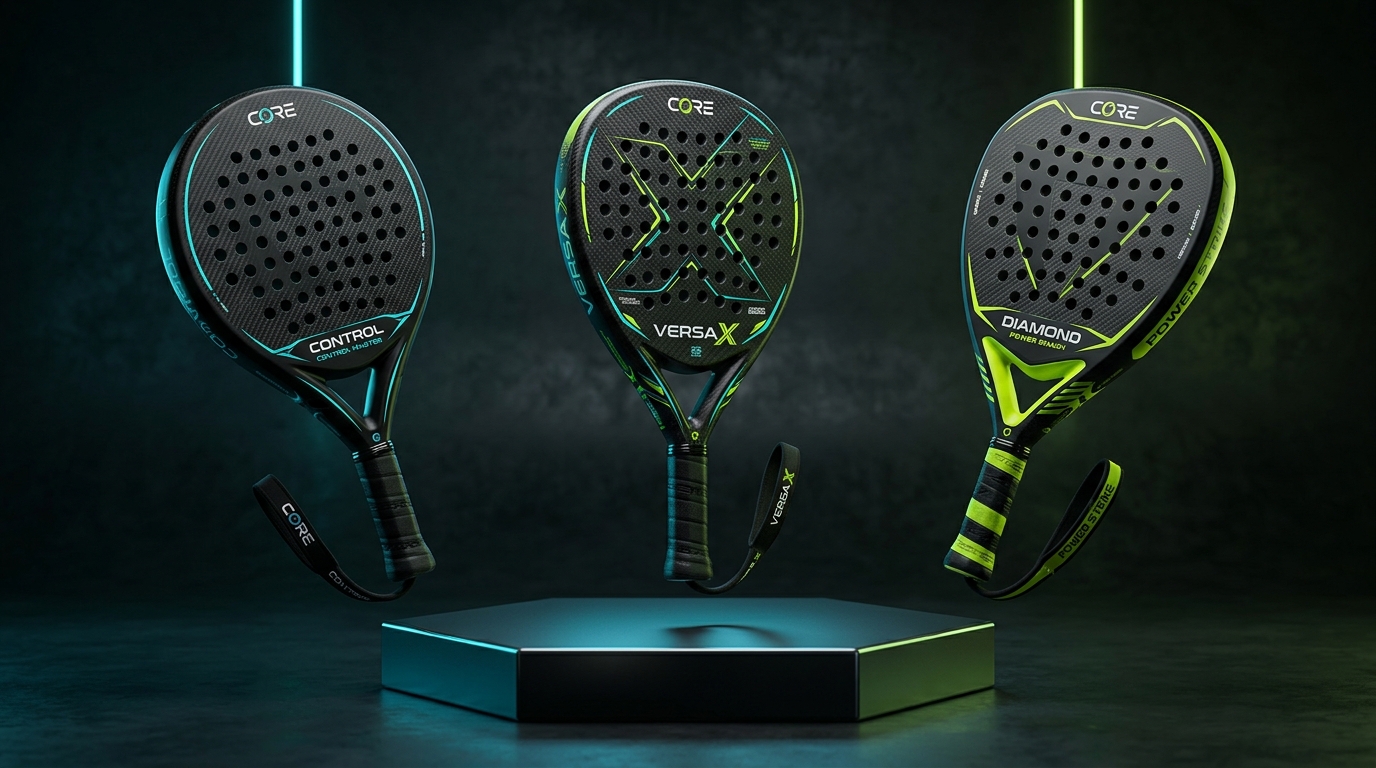
1. Round Shape
Balance: Low (Handle-heavy)
Sweet Spot: Wide & Centered
Best For: Beginners, defensive baseline tacticians, and players recovering from tennis elbow.
Delivers maximum forgiveness on off-center strikes and supreme control during rapid net volleys.
2. Teardrop (Drop) Shape
Balance: Medium (Even distribution)
Sweet Spot: Upper-Center
Best For: Intermediate to advanced all-rounders who transition between baseline and net.
The most versatile geometry in modern padel, balancing defensive touch with overhead acceleration.
3. Diamond Shape
Balance: High (Head-heavy tip)
Sweet Spot: Compact, top of frame
Best For: Aggressive tournament smashers and left-court finishers.
Maximum centrifugal leverage for hitting explosive overheads (Remate Por Tres / Por Cuatro).
Foam Core Densities: Soft EVA vs Hard / Pro EVA
Inside the carbon fiber shell lies the foam core. Soft EVA (or FOAM) absorbs ball impact and acts as a trampoline, generating effortless ball exit speed at low swing speeds while dampening arm vibration. Hard / Pro EVA provides higher structural rigidity; at high swing speeds, it does not absorb kinetic energy, transferring 100% of your muscular power directly into the ball for maximum finishing speed.
Chapter 6: The Tactical Shot Playbook & Biomechanics
Padel features a unique biomechanical shot vocabulary distinct from any other sport. Below are the 6 foundational strokes every player must practice:
1. La Bandeja (The Tray Shot)
Defensive OverheadWhen pushed back from the net by a deep lob, you do not hit a high-risk tennis smash. Instead, you turn sideways, raise your racket flat like a waiter carrying a tray, and slice underneath the ball at eye height.
Tactical Goal: Hits deep into the opponent's glass corners with heavy backspin, keeping the bounce low and allowing your team to preserve the dominant net position.
2. La Víbora (The Viper)
Offensive OverheadAn aggressive overhead struck on the outside lateral edge of the ball with high-speed side-spin.
Tactical Goal: The side-spin causes the ball to whip erratically off the side and back glass, hugging the ground and forcing unforced errors from defenders.
3. Remate Por Tres (Smash x3)
Spectacular FinisherA heavy topspin kick smash hit from midcourt that bounces on the opponent's turf, rebounds violently off the back glass, and arcs upward out over the 3-meter side fence.
Tactical Goal: An unreturnable point-winner unless an opponent sprints through the court door to retrieve it outside the court.
4. La Chiquita (The Little Dipper)
Baseline TransitionA slow, dipping drive struck from the baseline aimed directly at the feet of volleyers stationed at the net.
Tactical Goal: Forces the net players to hit an awkward upward volley, enabling your team to advance and steal the net.
Chapter 7: 2v2 Doubles Positioning & Tactical Geometry
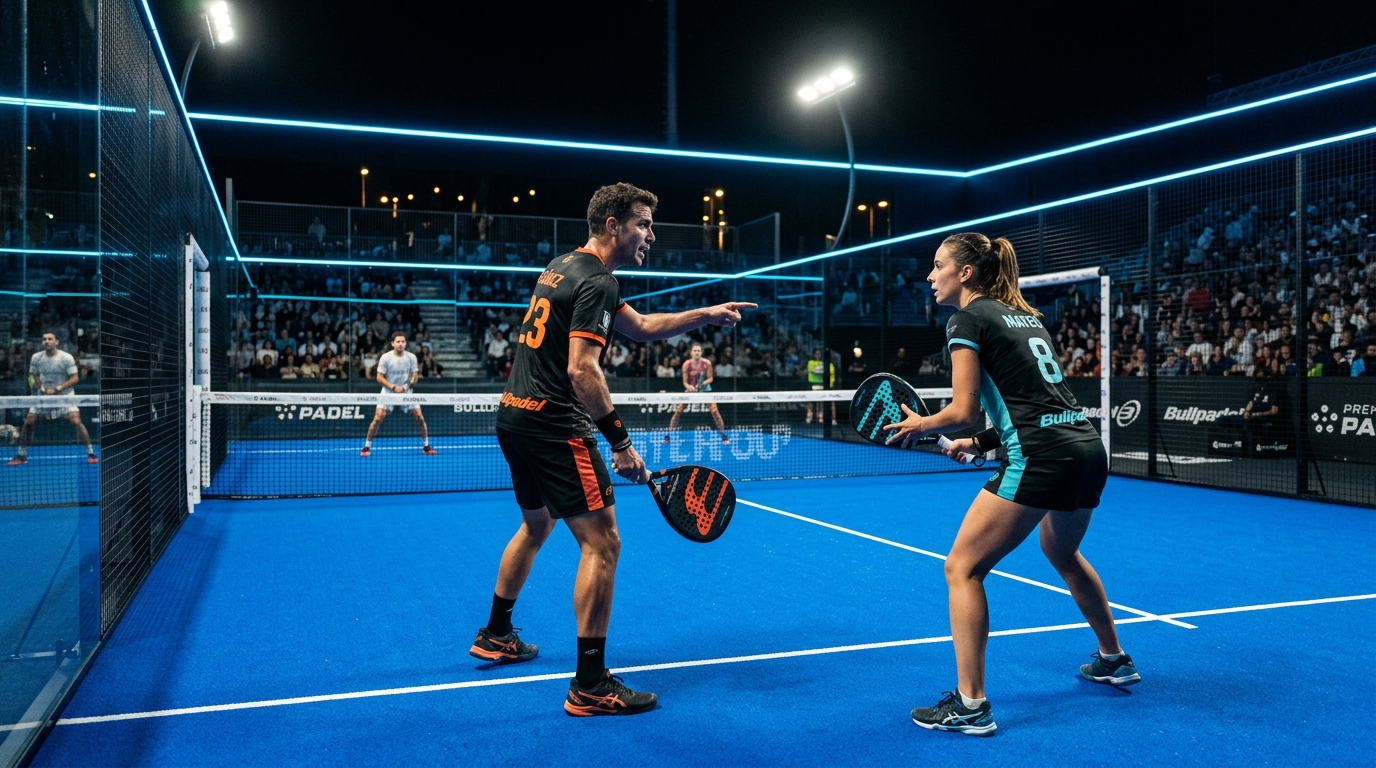
Padel is fundamentally a doubles sport where synergy and spatial coverage outweigh individual athletic prowess. Over 70% of points in professional padel are won by the team occupying the net position.
The "Linked Chain" Principle
Partners must imagine an invisible 4-meter rope connecting their waists. When player A shifts toward the side glass to cover a wide angle, player B must shift inward toward the center seam to close the middle channel. When lobbed, both players drop back to the baseline in unison. Leaving one player stranded at the net while the other retreats creates an easy diagonal passing lane for opponents.
The Left Court Player (El Revés)
Typically the more aggressive, powerful attacker. Because high overheads in the center of the court land on the left player's forehand, they are responsible for covering 60% of overhead smashes and executing point-ending remates.
The Right Court Player (El Drive)
The strategist and playmaker. Focuses on consistency, precision bandejas, opening up angles, and controlling tempo to set up easy finishing opportunities for the left-side partner.
Chapter 8: Technical Comparison: Padel vs Pickleball vs Tennis
While all three sports share racket DNA, their core dynamics diverge significantly:
| Feature | Padel | Pickleball | Tennis |
|---|---|---|---|
| Court Size | 10m x 20m | 6.1m x 13.4m | 23.77m x 10.97m |
| Enclosure | Glass & Steel (In play) | None | None |
| Racket | Solid foam & carbon | Flat composite paddle | Stringed hollow frame |
| Ball | Low-pressure felt | Perforated plastic | High-pressure felt |
Chapter 9: Footwear, Silica Sand & Injury Prevention
Because padel is played on sand-infilled artificial turf with frequent explosive 180-degree pivots, proper footwear is paramount:
- Herringbone (Clay) Outsoles: Provide the optimal balance of traction and controlled lateral sliding, preventing abrupt shoe lock-up that causes meniscus and ACL tears.
- Rotator Cuff Conditioning: Padel emphasizes frequent high-volume overhead bandejas and viboras. Performing internal and external resistance-band rotations prior to play reduces shoulder impingement.
- Elbow Health: Choose a round-shape racket with soft EVA foam if you experience forearm tightness, as high-vibration diamond power bats can exacerbate epicondylitis.
Chapter 10: Frequently Asked Questions (Master FAQ)
Q: Can you play padel singles (1v1)?
A: While 99% of competitive tournaments are 2v2 doubles on standard 10x20m courts, dedicated 1v1 singles courts (measuring 6m x 20m) exist for solo practice. On standard courts, players can also play diagonal "cross-court" 1v1 training sets.
Q: How long does an average padel match last?
A: A standard best-of-3 set padel match typically lasts between 60 to 90 minutes. Because rallies are extended by the glass walls, active ball-in-play time is significantly higher than in traditional tennis.
Q: Can you run outside the court to hit a ball back?
A: Yes! In sanctioned tournament courts with official clearance zones (Salida de Pista), players are allowed to sprint through the court side door to return an opponent's Remate Por Tres before it bounces a second time on the outside floor.
Ready to Test Your Padel Mastery?
Jump into the browser-based Padel Championship Arena. Practice wall rebounds, execute bandejas, and climb through 6 AI difficulty tiers.