How to Play Padel: The Complete Rules & Regulations
An authoritative, step-by-step breakdown of regulation padel rules, underhand serve specifications, glass wall physics, metallic mesh deflections, and tournament scoring.
| Rule | Key Requirement | Common Infraction |
|---|---|---|
| 1. Underhand Serve | Bounce behind line; strike at/below waist | Hitting above waist; ball hitting fence |
| 2. Glass Walls | Ball must bounce on turf before hitting glass | Hitting glass on the full (out) |
| 3. Metallic Fence | In play during rallies after floor bounce | Hitting your own side fence |
| 4. Scoring | 15-30-40-Game + Golden Point at deuce | Playing advantage when Golden Point active |
| 5. Doubles 2v2 | Move in tandem to control the net | Splitting formation across court |
The Underhand Serve
Serving in padel is strictly an underhand motion designed to initiate the point fairly rather than produce an unreturnable ace. The server stands behind the service line between the center dividing line and the side glass wall.
Regulation Requirements
- The ball must be bounced on the turf behind the service line before contact (it cannot be tossed into the air).
- At the exact moment of impact, the ball must be at or below waist level.
- The server must maintain at least one foot in contact with the ground throughout the swing.
- The ball must cross the net diagonally into the opponent’s opposite service box.
Fault Condition: If the ball strikes the metallic side fence after bouncing in the box, it is an immediate fault. If it strikes the glass wall after bouncing, the serve is 100% legal.
Tactical Tip: Aim for the corner where the side glass meets the back glass. A ball that hits the glass at a shallow angle dies close to the floor, forcing a difficult defensive scoop.
Glass Wall Rebound Mechanics
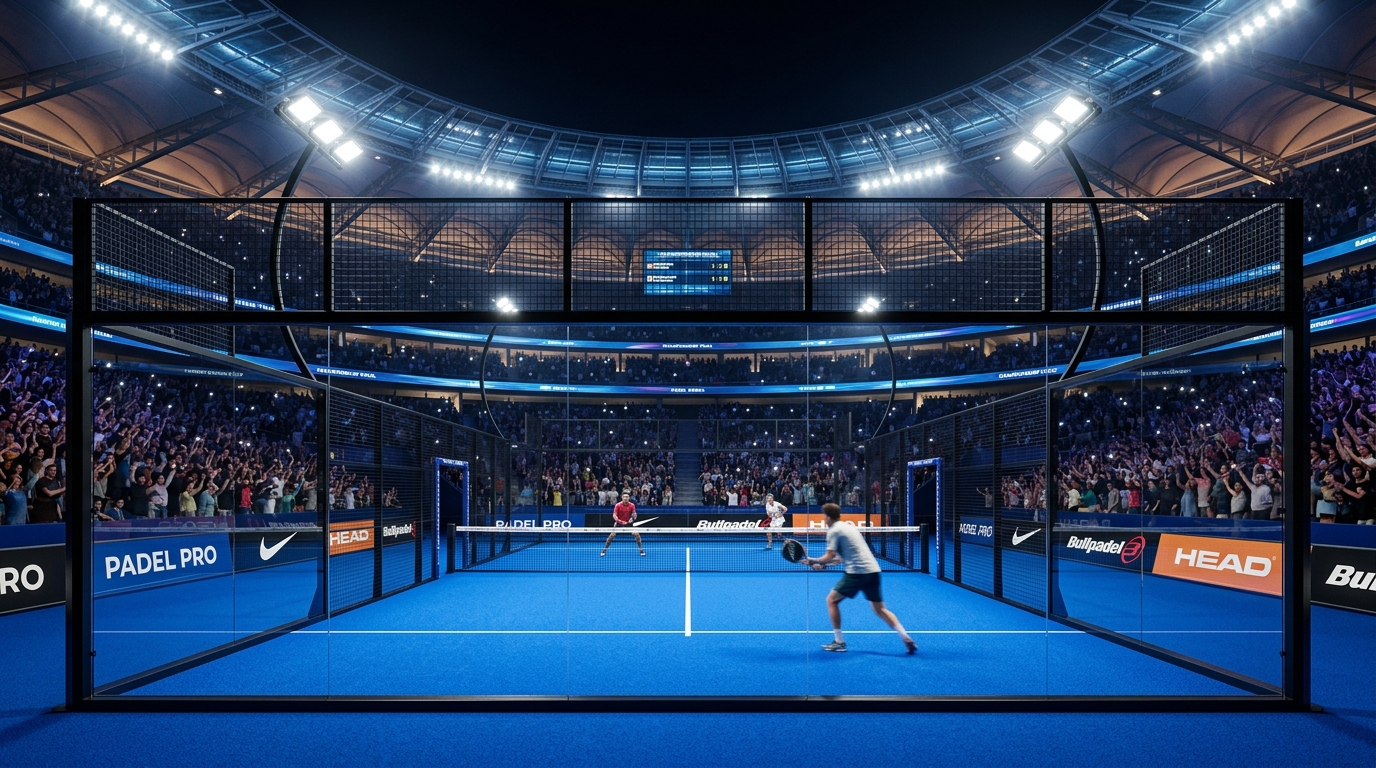
The surrounding tempered glass walls are an active element of padel gameplay. Once an incoming ball bounces once on your court floor, it can strike any number of glass walls and remain completely in play.
Regulation Requirements
- The ball must always make contact with the turf before striking the glass wall.
- If an incoming ball hits the glass wall directly on the full without bouncing on the floor first, it is ruled out.
- Players can let the ball rebound off the back glass, side glass, or double-wall corner before making their return.
- You are legally permitted to hit the ball into your own back glass wall so that it rebounds forward over the net.
Fault Condition: You cannot hit the ball directly into your own metallic side fence. Hitting your own fence results in an immediate loss of the point.
Tactical Tip: When a deep lob is hit over your head, do not backpedal awkwardly. Run past the ball toward the back glass, turn sideways, and let the wall bring the ball back into your hitting zone.
Metallic Mesh (Fence) Regulations
The metallic steel mesh panels along the sides introduce irregular deflections. Unlike the smooth, predictable rebound of tempered glass, the mesh absorbs ball speed and deflects the ball downward or sideways at erratic angles.
Regulation Requirements
- During active rallies, a ball that bounces on the floor and then strikes the metallic mesh is fully in play.
- Defending off the mesh requires quick reflexes because the rebound angle cannot be calculated mathematically.
- On the serve, any contact with the metallic fence after the bounce is an automatic fault.
- Attacking players intentionally aim slice volleys at the mesh to force unforced errors.
Fault Condition: Players may never strike the ball against their own side fence to return it over the net.
Tactical Tip: When hitting low slice volleys from the net, direct the ball toward the side fence 2 meters past the net posts to create an irregular downward deflection.
Scoring & The Golden Point (Punto de Oro)
Padel follows the traditional tennis scoring structure: 15, 30, 40, Game. Matches are played as best-of-3 sets, with the first team to win 6 games (by a margin of 2) winning the set. A 7-point tiebreak is played at 6-6.
Regulation Requirements
- Points progress as 15, 30, 40, and Game.
- Sets are won by reaching 6 games with a 2-game advantage (e.g., 6-4, 7-5).
- At 6-6 in games, a standard 7-point tiebreak is contested.
- Most modern tournament circuits, including the FIP tour, utilize the Golden Point (Punto de Oro) rule.
Fault Condition: Under Golden Point rules at 40-40, there is no Advantage. The receiving team chooses which partner receives the serve, and that single point decides the game.
Tactical Tip: On Golden Point return points, select the receiver with the highest percentage cross-court return and hit a low dipping ball directly at the server’s feet.
2v2 Doubles Positioning & Tandem Movement
Competitive padel is exclusively contested as a 2v2 doubles sport. Because court space is compact (10m x 20m), the team controlling the net wins over 70% of points. Doubles partners must operate in synchronized harmony.
Regulation Requirements
- The Linked Chain Rule: Partners move forward to attack together and retreat to the baseline together.
- Left Player (Drive / Rematador): Covers the middle channel overheads and executes explosive finishing smashes.
- Right Player (Creator / Creador): Controls the pace of rallies with defensive bandejas and low unforced error rates.
- Australian Formation: Partners maintain fixed left and right positions on every point, regardless of who serves.
Fault Condition: Splitting formation (one player at the net while the other is trapped at the baseline) exposes a wide diagonal angle that opponents will exploit immediately.
Tactical Tip: Constant verbal communication is essential. The partner not hitting the ball should call opponent positions: "Both at net", "Switching", or "Deep baseline".