Quick Comparison: Technical Specifications
The table below outlines the core regulation differences across court dimensions, ball physics, equipment, and scoring formats defined by the International Padel Federation (FIP), USA Pickleball (USAP), and the International Tennis Federation (ITF).
| Specification | Padel (FIP) | Pickleball (USAP) | Tennis (ITF) |
|---|---|---|---|
| Court Dimensions | 10.00m × 20.00m (200 m²) | 6.10m × 13.41m (81.8 m²) | 10.97m × 23.77m (260.8 m² doubles) |
| Court Enclosure & Walls | Tempered glass (3–4m) & steel mesh (Active in play) | None (Open court with painted boundaries) | None (Open court with perimeter fencing) |
| Playing Surface | Monofilament artificial turf with silica sand | Hardcourt acrylic / textured asphalt | Hardcourt acrylic, red clay, or natural grass |
| Net Height | 88 cm center / 92 cm at posts | 86.4 cm center (34") / 91.4 cm posts (36") | 91.4 cm center (36") / 107 cm posts (42") |
| Racket / Paddle Type | Solid carbon-fiber frame, 38mm EVA foam core (Palas) | Solid polymer honeycomb core, carbon/fiberglass face | Hollow graphite composite frame with strung synthetic/gut |
| Ball Type & Dynamics | Felt wool rubber ball, low pressure (~10–11 psi) | Perforated molded plastic wiffle ball (26–40 holes) | High-pressure felt wool rubber ball (~14 psi / 0.95 bar) |
| Serve Mechanics | Underhand bounce serve below waist level | Underhand drop/volley serve below navel | Overhead toss with kinetic chain strike (100–140+ mph) |
| Non-Volley Restrictions | None (Players can volley directly at the net) | 7-foot "Kitchen" zone on both sides of net | None (Players can volley anywhere inside boundary) |
| Scoring System | 15-30-40-Game + Punto de Oro (Golden Point at 40-40) | Side-out scoring to 11 (Server scores only, win by 2) | 15-30-40-Game with Advantage scoring to 6-game sets |
| Primary Playing Format | Exclusively 2v2 doubles in tournament play | Both doubles and singles widely contested | Singles and doubles contested equally |
| Avg. Rally Length | 8 to 18 shots (Glass walls keep balls live) | 6 to 14 shots (Fast-reflex kitchen firefights) | 3 to 7 shots (High velocity, wide court winners) |
| Calorie Burn / Hour | 650 – 850 kcal / hour (Continuous interval sprints) | 400 – 600 kcal / hour (Low impact lateral steps) | 600 – 900 kcal / hour (High-impact long sprints) |
| Learning Curve | Low entry barrier (15 mins to rally), high tactical ceiling | Lowest entry barrier (10 mins to play), rapid mastery | Steep entry barrier (Requires months of technical coaching) |
| Governing Body | FIP (International Padel Federation / Premier Padel) | USA Pickleball (USAP) / PPA / MLP | ITF (International Tennis Federation) / ATP / WTA |
1. Court Size & Architecture
The most immediate difference between the three sports is the playing area and physical boundaries:
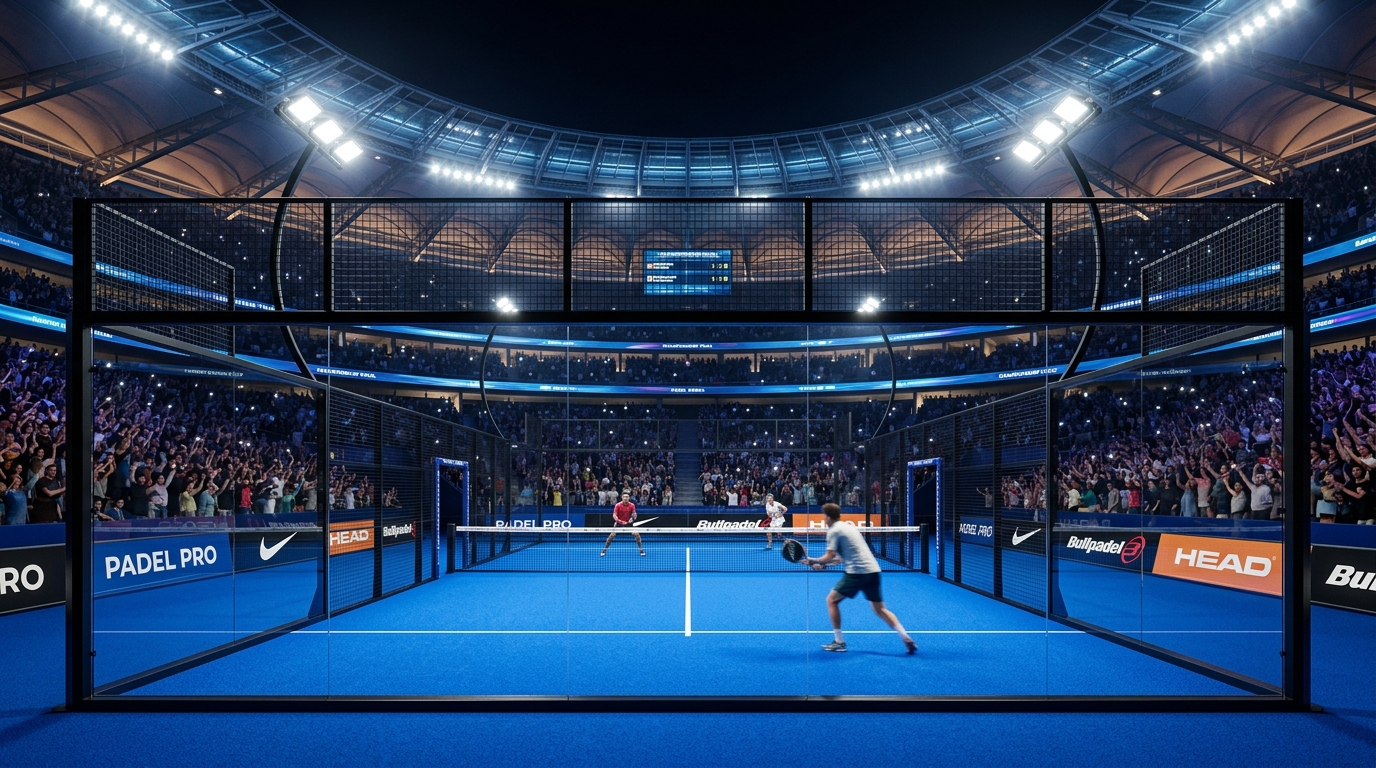
Padel (10m × 20m): A padel court measures 10 meters wide by 20 meters long (200 square meters) and is entirely enclosed by 3-meter to 4-meter tempered glass walls and electro-welded metallic mesh fencing. Because the walls act as active boundaries, there are no out-of-bounds run-off zones. This compact footprint allows facilities to build three padel courts within the footprint of a single traditional tennis court.
Pickleball (6.1m × 13.4m): A pickleball court matches the dimensions of a standard badminton doubles court (81.8 square meters). The court is open and marked with flat painted boundary lines. Up to four temporary or permanent pickleball courts can fit inside a single standard tennis court area.
Tennis (10.97m × 23.77m): A regulation tennis doubles court measures 260.8 square meters, but requires extensive out-of-bounds perimeter clearance (often 600+ square meters total) to allow players to chase wide balls and heavy baseline groundstrokes safely.
2. The Physics of Wall Rebounds vs Open Boundaries
In pickleball and tennis, when a ball lands beyond the baseline or sideline, the rally immediately ends and the opponent is awarded the point.
In padel, the perimeter walls are an active continuation of play. As long as an incoming ball bounces once on the turf before hitting the glass or metallic mesh, it remains completely live. Defending players regularly allow high-speed balls to pass them, letting the ball rebound off the back glass before striking a counter-attacking Bajada de Pared or Salida de Pared back into the opponent’s court.
Tempered glass delivers a clean, predictable rebound, whereas the metallic side fence creates sharp, unpredictable deflections. Hitting the ball with excessive power in padel without tactical spin often backfires, as a fast ball rebounds high off the opponent's back wall and provides them with an easy overhead opportunity.
3. Racket vs Paddle vs Tennis Racquet
Each sport relies on distinct striking equipment designed for its specific ball weight and court size:
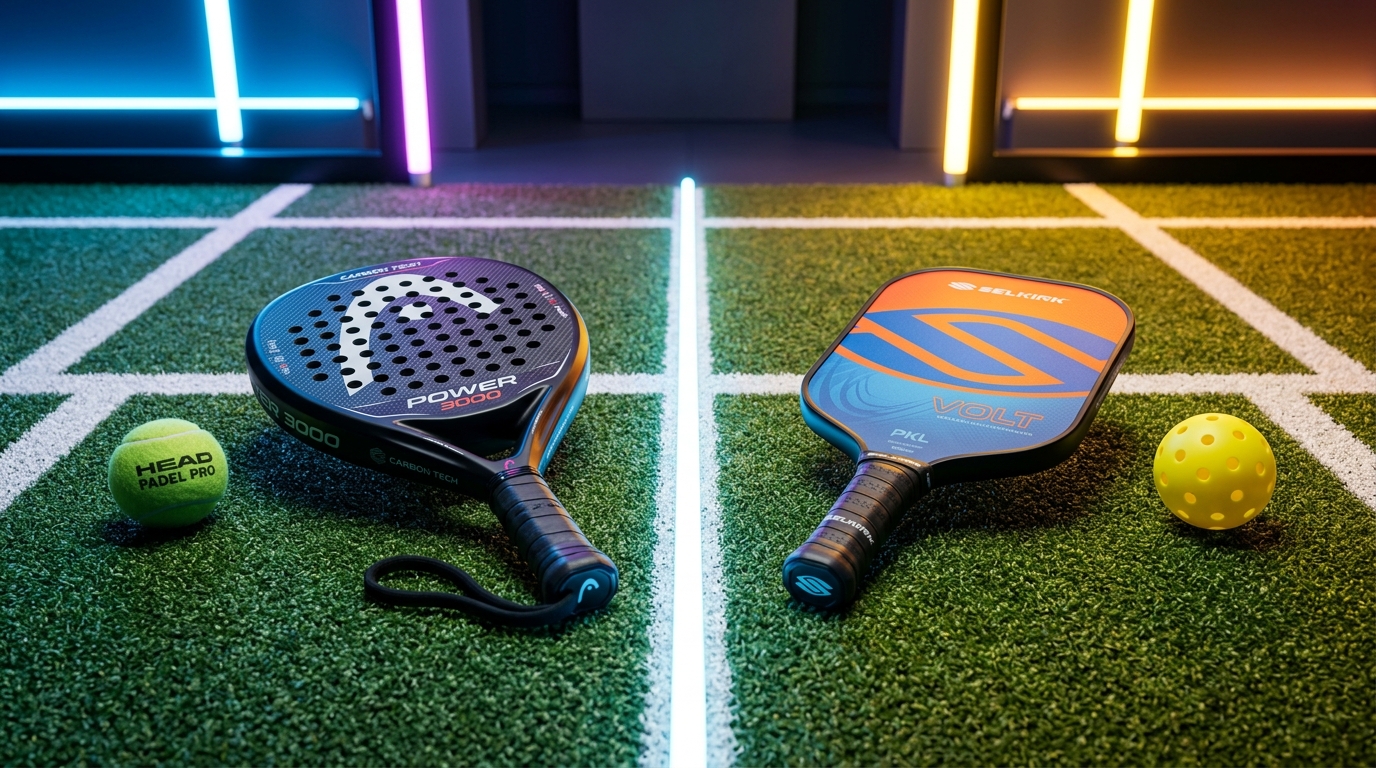
- Padel Racket (Pala): Solid composite construction with a standard 38mm thickness and perforated aerodynamic holes. Palas feature an internal high-memory EVA foam or polyethylene core, wrapped in 3K, 12K, or 18K carbon fiber. Weighing between 355g and 375g, padel rackets are relatively heavy and feature a mandatory wrist safety cord attached to the handle.
- Pickleball Paddle: A thin, flat paddle typically 13mm to 16mm thick, consisting of a lightweight polymer or Nomex honeycomb core with a carbon-fiber, graphite, or fiberglass face. Weighing between 210g and 245g (7.5 to 8.5 ounces), it is significantly lighter than a padel racket and has an unperforated solid face.
- Tennis Racquet: A 27-inch hollow graphite/carbon frame strung with polyester, synthetic gut, or natural gut strings under 48 to 60 pounds of hydraulic tension. The open string bed creates a trampoline effect that imparts high velocity and topspin on contact.
4. Ball Aerodynamics, Internal Pressure & Bounce
The ball design directly dictates rally speed, flight predictability, and spin mechanics:
Padel Ball: Appears almost identical to a standard tennis ball (felt rubber sphere), but is pressurized approximately 0.06 bar lower (~10–11 psi). This slight reduction in internal pressure prevents excessive rebound velocity off rigid carbon rackets and solid glass walls, producing sustained, controlled rallies.
Pickleball Ball: A hollow, perforated plastic wiffle ball with 26 (indoor) or 40 (outdoor) drilled holes. The holes produce significant aerodynamic drag, preventing high speeds and limiting spin retention during flight.
Tennis Ball: High internal pressure (~14 psi) combined with heavy felt enables maximum exit speeds off stringed racquets, allowing elite players to strike 120+ mph serves and heavy topspin groundstrokes that dip sharply.
5. Tactical Positioning: The Net War vs The Kitchen (NVZ)
Court tactics revolve around very different net dynamics across all three sports:
Padel (The Net War): In competitive padel, more than 80% of winning points are finished from the net. There is no non-volley zone; players can stand directly at the net to hit volleys, block incoming smashes, and execute overheads such as the Bandeja (flat/sliced defensive overhead) or Vibora (side-spin offensive strike). Defending players frequently use high lobs to push the attacking team back to the glass and reclaim the net.
Pickleball (The Non-Volley Zone / Kitchen): Pickleball enforces a strict 7-foot non-volley zone on both sides of the net. Players cannot step inside the kitchen or on the kitchen line to strike a ball out of the air. This rule forces players to master the "third-shot drop" to approach the kitchen line safely and engage in patient "dinking" exchanges until an opponent leaves the ball high enough for a speed-up.
Tennis (Baseline Battles): Modern tennis is played primarily from the baseline, emphasizing heavy topspin depth, lateral footwork, and aggressive sideline angles. Approaching the net is an intentional finishing strategy rather than a permanent default position.
6. Serving Rules & Two-Bounce Constraints
The serve sets the tone for point progression:
Padel Serve: Must be performed underhand after bouncing the ball once behind the service line. The contact point must be at or below waist height. The ball is served diagonally into the opponent's service box. After landing in the box, the ball can bounce off the back glass, but if it touches the metallic side fence before or after the bounce, it is faulted.
Pickleball Serve & Two-Bounce Rule: The serve is struck underhand below the navel with an upward paddle swing. Under the Two-Bounce Rule, the receiving team must let the serve bounce, and the serving team must let the return bounce before either team can hit a volley out of the air.
Tennis Serve: An explosive overhead kinetic strike from behind the baseline, reaching high speeds and allowing dominant servers to earn outright aces and unreturnable service winners.
7. Scoring Systems: Punto de Oro vs Side-Out
Padel: Uses traditional tennis scoring (15, 30, 40, Game) across best-of-three 6-game sets with tiebreaks. In modern FIP and Premier Padel tournaments, the Punto de Oro (Golden Point) rule is applied: at 40-40 deuce, no advantage is played. Instead, a single sudden-death point determines the game winner, with the receiving team choosing which side receives the serve.
Pickleball: Traditional play uses side-out scoring to 11 points (win by 2), meaning only the serving team can score. If the receiving team wins a rally, they earn the serve (a side-out) rather than a point. Modern team leagues (MLP) have adopted rally scoring to 21 for faster, predictable broadcast times.
Tennis: Standard 15, 30, 40, Game format with Advantage scoring requiring a two-point margin to secure games at deuce.
8. Physical Demands, Calorie Burn & Joint Impact
Cardiovascular intensity and biomechanical stress differ notably between the sports:
Padel (650–850 kcal/hour): Long rallies (often 12–20 shots) demand continuous multidirectional movement, deep defensive squats off the glass, and explosive overheads. The monofilament artificial turf with silica sand absorbs impact, reducing knee and ankle shock compared to rigid asphalt courts.
Pickleball (400–600 kcal/hour): Shorter court dimensions require fast lateral shuffles and hand-speed reflexes with less total running distance. It is gentle on the cardiovascular system and highly accessible for all ages, though playing on hard asphalt courts can still place stress on Achilles tendons and knees.
Tennis (600–900 kcal/hour): Full-court sprints and heavy decelerations place high demands on the lower body, while high-velocity serves and string vibrations contribute to higher rates of tennis elbow and shoulder rotator cuff strain.
9. Which Sport Should You Play?
Choose Padel if: You want an engaging, high-energy 2v2 social sport with 3D tactical depth, continuous rallies, and a fast learning curve that is easy on the joints.
Choose Pickleball if: You want a fun, low-barrier sport that you can pick up in 10 minutes, with accessible public park courts and an emphasis on quick hand reflexes at the kitchen line.
Choose Tennis if: You enjoy traditional full-court athleticism, powerful serves, 1v1 singles competition, and have the patience to invest in formal coaching for stroke technique.
Frequently Asked Questions
Is padel easier to learn than tennis?
Yes. Because padel utilizes shorter solid rackets without long lever arms, low-pressure balls, underhand serves, and enclosing walls that keep stray balls in play, beginners can sustain enjoyable 10-to-20 shot rallies within their first 15 minutes of play.
Can you use a tennis ball or pickleball for padel?
No. Tennis balls have higher internal pressure (~14 psi), causing uncontrollable rebounds off padel glass walls. Pickleballs are perforated plastic wiffle balls that cannot compress against carbon palas. Padel requires FIP-certified low-pressure felt rubber balls.
Why is padel played exclusively as doubles?
While custom singles courts exist, FIP tournament padel is strictly 2v2 doubles. The 10m × 20m geometry is tactically optimized for two partners to cover baseline rebounds while coordinating attacking net coverage.
Can you hit the ball out of the court in padel?
Yes. When a player strikes a smash with heavy topspin so that it bounces on the turf, hits the opponent's back glass, and kicks over the 3m side wall or 4m back wall (Por Tres / Por Cuatro), it is a winning shot—unless an opponent sprints out through the side court door to hit the ball back into the court before it bounces outside.
Which sport provides the best cardiovascular workout?
Both padel and tennis burn between 650 and 900 calories per hour, which is substantially higher than recreational doubles pickleball (400–600 kcal/hour), due to continuous multi-directional sprints, active wall retrievals, and extended rally counts.