Padel Racket Guide: Shapes, Foam Cores & Balance
Unlike stringed tennis rackets, padel rackets (palas) are solid 38mm composite carbon-fiber frames with perforated foam cores. Understanding how shape, balance, and core materials influence performance is essential for finding the right racket for your game.
Racket Shape Quick Comparison
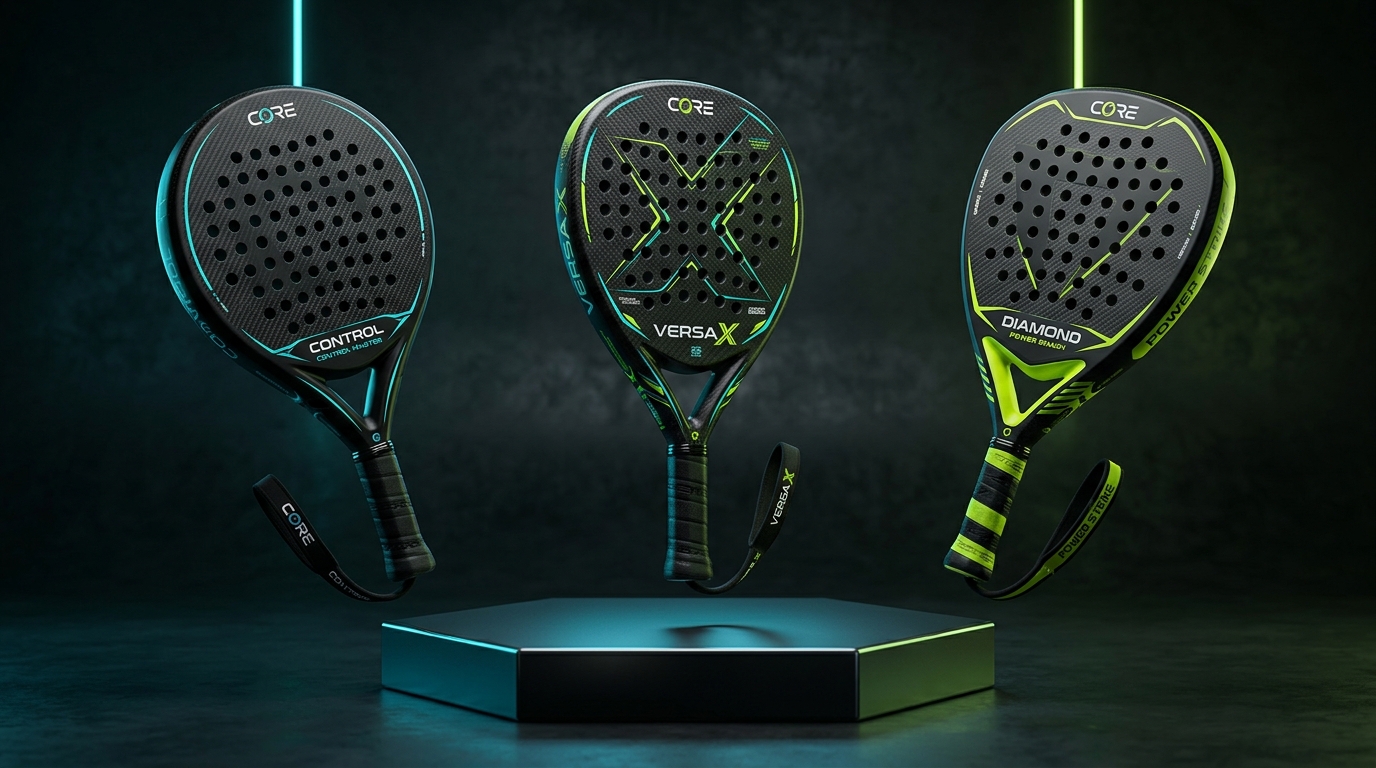
| Shape | Balance | Sweet Spot | Playstyle |
|---|---|---|---|
| Round | Low (Handle) | Large & Centered | Control, Defense, Beginners |
| Teardrop | Medium (Even) | Medium (Upper-Center) | All-Round, Versatile, Intermediate |
| Diamond | High (Head-Heavy) | Compact (Tip) | Power, Smashes, Advanced |
Round Shape: Maximum Control and Forgiveness
Round rackets are engineered with the center of mass closer to the grip. This low balance reduces rotational inertia, making the racket exceptionally easy to maneuver during fast baseline defense and wall pickups. The generous sweet spot in the center ensures that off-center contacts retain predictable direction and speed, while dampening vibrations that contribute to arm strain.
Best Suited For: Beginners, defensive players, and right-court strategists who prioritize placement and low unforced error rates.
Key Performance Characteristics
- Maximum surface forgiveness on off-center contact near the frame edge
- Low center of mass protects the wrist, forearm, and elbow from fatigue
- Quick handling for rapid defensive adjustments off the back glass
Trade-off: Lower head-speed leverage makes generating explosive smash power more physically demanding.
Teardrop Shape: Balanced Power and Precision
The teardrop (or drop) geometry is the most widely used profile on modern competitive circuits. By tapering the lower frame and expanding the upper hitting surface, it strikes a balance between defensive control and overhead finishing power. It provides enough mass at the top to accelerate bandejas and viboras without sacrificing quick reaction time at the net.
Best Suited For: Intermediate to advanced all-rounders who actively transition between baseline defense and attacking net volleys.
Key Performance Characteristics
- Versatile performance across all court zones and shot types
- Effective balance for overhead spin shots and controlled drop volleys
- The standard choice for intermediate players refining their tactical style
Trade-off: Slightly smaller sweet spot than a round frame, requiring more consistent ball striking.
Diamond Shape: Maximum Overhead Power
Diamond rackets concentrate structural mass toward the top of the head. This head-heavy balance acts as a lever arm during overhead swings, transferring maximum kinetic energy into the ball. For players capable of timing the compact sweet spot near the tip, diamond rackets deliver the velocity and topspin required to hit the ball out of the court on a Remate Por Tres.
Best Suited For: Aggressive left-court attackers and advanced tournament players with high swing speeds who finish points with overhead smashes.
Key Performance Characteristics
- Maximum torque and velocity on overhead smashes and aggressive volleys
- High-density contact zone creates crisp, explosive ball exit speed
- Unmatched finishing speed when attacking from the net
Trade-off: Small sweet spot and head-heavy weight demand precise footwork and timing on defensive rebounds.
Foam Core Densities: Soft EVA vs Hard EVA
The interior foam core determines how the ball rebounds off the racket surface and how much vibration reaches your arm:
Soft EVA / FOAM Cores
Soft foam provides greater elasticity and a "trampoline effect," generating effortless ball speed on low-velocity swings. It absorbs vibration effectively, making it comfortable on the arm and ideal for baseline defense.
Hard / Pro EVA Cores
High-density foam is stiffer and absorbs less kinetic energy during aggressive swings. This transfers maximum power directly into the ball on overhead smashes, giving advanced players pinpoint directional precision.