Padel Doubles Tactics & Positioning Playbook: Drive vs. Revés, The Middle Rule & Surviving “La Nevera”
Padel is not two individuals hitting balls inside a cage; it is a synchronized human chess match where partners function as a single biological unit. Master the invisible rope geometry, role specialization between Drive and Revés, the non-negotiable middle rule, and how to survive the psychological torture of La Nevera.
📑 Playbook Table of Contents
- The “Invisible Rope” Theory of Court Geometry
- Right (Drive) vs. Left (Revés): Personality & Skill Matrix
- The Golden Middle Rule: Center Court Ownership
- Australian Formation vs. Traditional Switching
- Navigating “No Man’s Land” and Net Attacks Together
- Surviving “La Nevera” (The Fridge): Tactical & Mental Survival
- The Psychology of Partner Chemistry: Blame vs. Synergy
- Four High-Intensity Doubles Drills for Match Day
- Frequently Asked Doubles Tactics Questions
1. The “Invisible Rope” Theory of Court Geometry
The single biggest differentiator between a 3.0 recreational pair and a 5.0 tournament powerhouse has nothing to do with how hard either player smashes the ball. It boils down to a fundamental law of physics and geometry: the two players on a padel court must move as if tied together by a 3-meter elastic bungee cord.
On a padel court measuring exactly 20 meters long by 10 meters wide, the net dividing the two halves is 10 meters wide. When one player charges forward to the net while their partner hesitates and lingers behind the service line, an enormous diagonal chasm is cleaved through the center of their defense. In competitive padel, any opponent with basic court vision will instantly hit an easy roll, chiquita, or angle into that yawning crevasse.
The 3 Rules of the Invisible Rope:
- Advance Together: When a deep lob pushes your opponents to the back glass, both you and your partner must take the net simultaneously. Never allow a staggered formation where one stands at the net and the other stays at the baseline.
- Retreat Together: When opponents send a quality lob over your partner’s head, you do not stand like a statue admiring the trajectory. You immediately sprint back together to set up your defensive wall baseline stance.
- Shift Laterally Together (The Windshield Wiper): When the ball is in your opponents’ right corner, your team shifts laterally toward that side to seal off the down-the-line passing angle while narrowing the crosscourt target.
Too many players trained in singles tennis treat their padel partner as an independent contractor occupying the adjacent five meters. In reality, padel is a game of space management. If you take three steps to the right fence to cover a wide bajada, your partner must take two steps toward the center T-line to close the gate. Failure to slide creates the infamous “middle canyon” that ends points instantly.
2. Right (Drive) vs. Left (Revés): Personality & Skill Matrix
One of the most consequential decisions you will make in padel is deciding which side of the court you will anchor. In the professional circuit (Premier Padel / World Padel Tour), players rarely swap sides mid-match. The demands of the Drive (Right Side) and Revés (Left Side) are radically different in biomechanics, shot repertoire, and mental constitution.
| Tactical Dimension | The Right Player (Drive) | The Left Player (Revés) |
|---|---|---|
| Primary Court Mission | The Architect / Point Builder. Low unforced errors, precision lobs, controlling tempo. | The Finisher / Assassin. Dominating overheads, punishing floating lobs, decisive winners. |
| Forehand Orientation | Forehand faces the right side wall/fence (if right-handed). Backhand covers the middle. | Forehand faces the middle line. High kinetic overhead leverage over 70% of the court. |
| Signature Shots | Deep crosscourt chiquita, controlled bandeja to the corner glass, deceptive wall drops. | Víbora with heavy sidespin, aggressive Bajada de pared off the back glass, Por Tres smash. |
| Mental Archetype | Zen master, disciplined, patient, high tactical IQ, impervious to frustration. | Predatory, confident, explosive, risk-tolerant, hungry to take responsibility on game points. |
| Pro Player Exemplars | Fede Chingotto, Martin Di Nenno, Sanyo Gutiérrez | Ale Galán, Agustín Tapia, Juan Lebrón |
The Left-Hander Cheat Code: The Righty-Lefty Dream Team
In padel, finding a left-handed partner is the tactical equivalent of striking gold. When a right-handed player stands on the Left side (Revés) and a left-handed player stands on the Right side (Drive), both players have their forehands in the middle of the court.
This alignment eliminates the traditional vulnerability where the right player’s backhand has to defend center drives. Furthermore, both players can execute devastating kick smashes and bandejas directed inward, creating an impenetrable offensive wall across the net. Famous historic partnerships like Fernando Belasteguín (Right-handed on Left) and Juan Martín Díaz (Left-handed on Right) dominated world padel for 13 undefeated years largely thanks to this geometrical perfection.
3. The Golden Middle Rule: Anatomy of Center Court Ownership
More unforced errors, awkward racket collisions, and bitter partner arguments occur along the center line than in any other square meter of a padel court. The phenomenon known as the “You-take-it-no-I-take-it” paralysis is what separates organized tournament competitors from disjointed club players.
The Universal Law: The Left Player Owns the Middle
In a standard pairing of two right-handed players, the player on the Left (Revés) has primary legal jurisdiction over all balls hit down the center 1.5-meter channel.
Why? Because the left-side player strikes the middle ball with their forehand or overhead smash. The right-side player would be forced to reach across their body with a cramped, defensive backhand or an off-balance reverse smash. Biomechanically, the forehand delivers 40% more leverage, greater rotational power, and a wider margin for error over the net strap.
The 3 Critical Exceptions to the Middle Rule
- The “Pushed to the Glass” Override: If the left player was forced deep into their backhand corner by a previous shot and is still scrambling back toward position, the right player must proactively claim the center. In this scenario, the right player shouts “MÍA!” (Mine!) loudly and decisively to relieve pressure.
- The Angle of Origin: When the ball is struck by the opponent standing in their crosscourt right corner, the natural trajectory angles toward the right player’s body. If the ball is clearly closer to the right player’s dominant strike zone, they should step forward and intercept it rather than forcing the left player to make an unnatural 3-meter sprint across the court.
- The Explicit Verbal Call Rule: If either player utters a decisive vocal call before the ball crosses the net, that call overrides all general positioning conventions. Indecision is the only true sin; hitting with the wrong hand is always better than watching the ball bounce untouched down the center.
4. Australian Formation vs. Traditional Switching
When your team is serving, you must choose between two distinct tactical systems: Traditional (Classical) Switching or the Australian Formation (I-Formation).
Traditional Switching
The non-serving partner starts at the net on the side opposite the service box. After serving, the server rushes straight forward to occupy their own side. When serving from the right box, the server stays right. When serving from the left box, the server stays left.
Cons: Both partners must be comfortable playing both Drive and Revés sides on alternate points.
Australian Formation
The non-serving player anchors permanently on their preferred side (e.g., the left). When the server must serve from the right, the partner remains on the left. The server must immediately sprint diagonally/laterally across the court to reach the right side net post before the return arrives.
Cons: The server leaves a massive down-the-line passing channel open while sprinting diagonally across.
⚠️ The Australian Formation Death Trap: The Down-The-Line Return
If you choose the Australian system, the server MUST serve with heavy slice bouncing toward the opponent’s side glass or body. A weak, floating serve down the center gives the returner an easy, aggressive down-the-line drive into the completely empty court that the server is desperately scrambling to reach.
5. Navigating “No Man’s Land” and Net Attacks Together
The area between 2 meters behind the net and 1 meter in front of the service line is known as No Man’s Land (La Zona de Transición). In padel, you must never linger here. You either live comfortably behind the service line playing wall defense, or you stand 1.5 to 2 meters from the net executing volleys and bandejas.
However, moving between these two zones is where doubles teams get dismantled. If an opponent hits a shallow lob or a weak drop, amateur pairs charge forward erratically. Here is the exact transition protocol to follow:
The Chiquita Bridge
When trapped at the baseline, hit a slow, dipping ball right at the feet of the net players (the Chiquita). Because they must volley upward from below the net band, they cannot hit an aggressive smash, giving both you and your partner the exact 1.5 seconds required to sprint from baseline to net in unison.
The “Lob Over the Weaker Overhead”
Never hit a flat drive to test net players with quick hands. Throw a high, deep lob toward the opponent with the less lethal bandeja/smash. While their head is tilted backward tracking the ball, you and your partner claim the attacking net position before their feet touch down.
Never Hit While Running Forward
If you are rushing from baseline to net and your opponents intercept the ball earlier than anticipated, perform an immediate split step to freeze your forward momentum before striking. Hitting on the dead run causes pop-ups and netted volleys.
6. Surviving “La Nevera” (The Fridge): Tactical & Mental Survival
There is no experience in modern racket sports more psychologically exhausting than being subjected to La Nevera (The Refrigerator / The Freezer). It occurs when your opponents identify a skill disparity or deliberately decide to direct 85% to 95% of every single ball to one partner, completely icing the other player out of the match.
❄️ If YOU Are the Frozen Player
- Active Footwork Shuffling: You cannot stand idle with your hands on your hips. Keep bouncing on your toes. Your nervous system cools down rapidly after 4 minutes without striking a ball.
- Encroach the Middle: Take two steps inward toward the center line. Make yourself physically larger and cut off balls that pass within 1.5 meters of your racket.
- Become the Match Radar: Call out opponent positions continuously (“Both at the net!”, “Left guy dropping back!”, “Switch!”). This keeps your brain engaged and relieves cognitive load from your overwhelmed partner.
- Zero-Pressure Finishers: When you finally touch the ball after 10 points of starvation, do NOT attempt an ego-driven 100 mph smash. Hit a solid, deep bandeja to get your rhythm back.
🔥 If YOU Are the Targeted Player
- Stop Going for Low-Percentage Hero Winners: You feel exhausted and rushed, which tempts you into hitting risky shots to end points. Resist this impulse.
- The Parallel (Down-The-Line) Escape: Crosscourt balls keep you trapped in the crosscourt duel. Hit a high, deep lob down the line or a parallel drop to the player freezing your partner out. This forces a crosscourt return directly into your frozen partner’s strike zone!
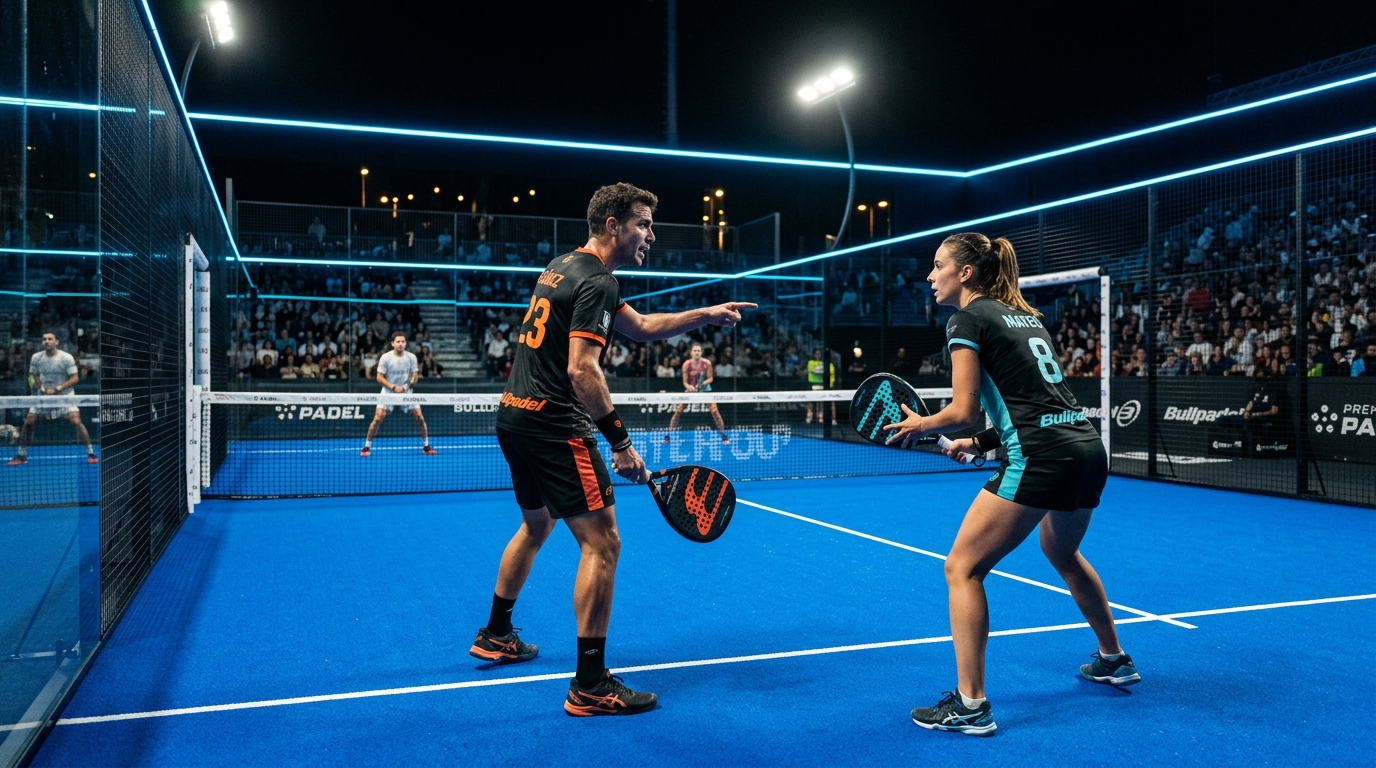
- Breathe and Reset: Take the full 20 seconds between points. Walk to the back glass, dry your grip, and take three deep diaphragmatic breaths to reset your heart rate.
7. The Psychology of Partner Chemistry: Blame vs. Synergy
Padel is an emotional amplifier. When you miss a simple putaway volley in tennis, you swallow your frustration alone. In padel, you look up and your partner is standing two meters away from you. A single eye-roll, a deep sigh, or slumped body language can cost your team 4 consecutive games.
The 3 Verbal Rules of Elite Padel Duos
1. Racket Touch After Every Point
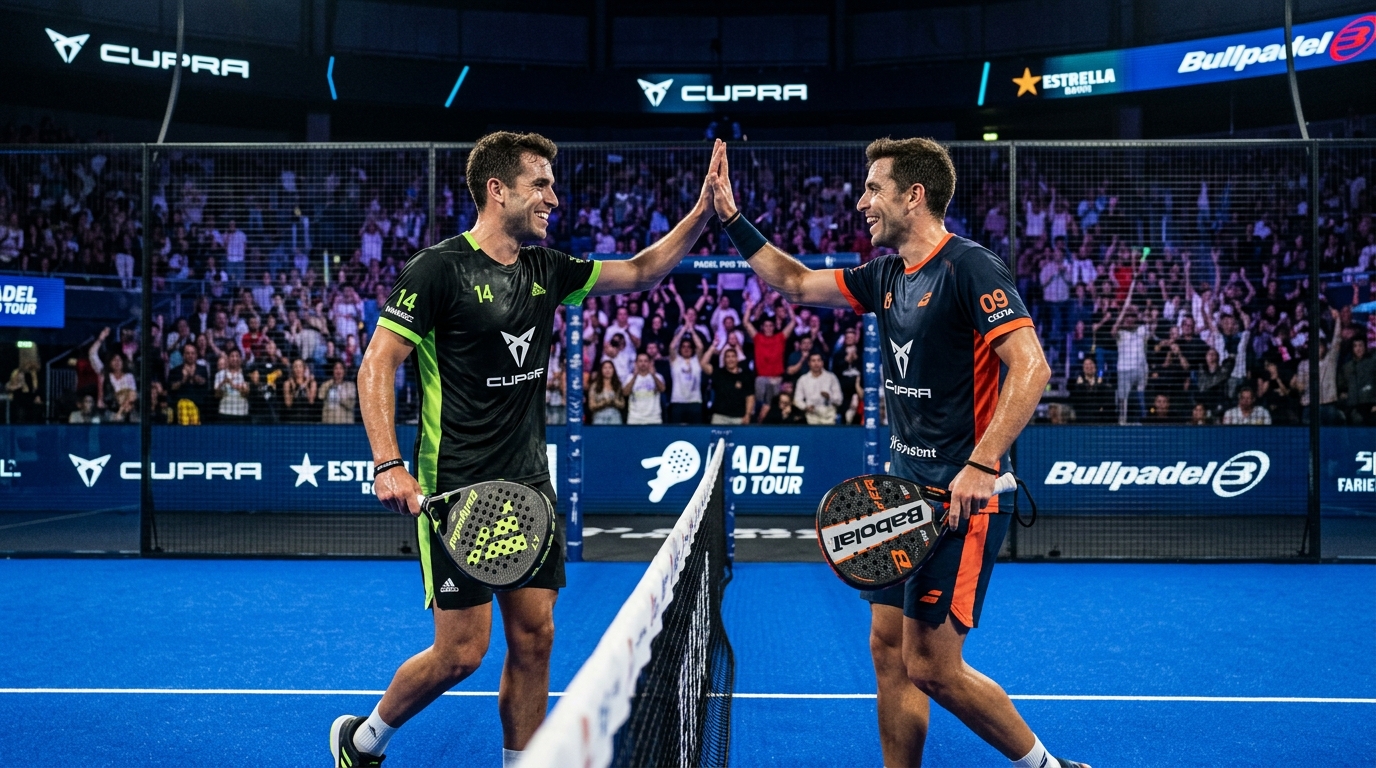
Whether the point ended in an ESPN-highlight smash or an embarrassing miss into the bottom of the net, tap rackets. Physical contact anchors emotional closure and signals immediate solidarity.
2. Forward-Looking Cues Only
Never say: “Why did you hit that into the glass?” Say instead: “Next time that ball comes, let’s put up a high lob to their backhand so we can reset.” Feedback must always describe the next action, not judge the past.
3. Decisive Micro-Cues on Defense
Standardize 3 core one-word calls: “MÍA” (I am taking it), “TUYA” (You take it), and “SUBE” (Take the net now). Ambiguous phrases like “I don’t know if you want that” lose points.
8. Four High-Intensity Doubles Drills for Match Day
The 3-Meter Elastic Cord Drill
Partners literally hold opposite ends of a 3-meter resistance band or rope while executing baseline-to-net transition rallies against coach feeds. If the rope stretches taut or goes limp, players are out of sync.
Center Line Chiquita Scramble
A ball machine feeds fast balls straight down the T-line. The left-side player must execute bandejas while calling “MÍA”, while the right-side player practices ducking and rotating to cover the opposite side angle.
Simulated “La Nevera” Pressure Match
Play a 10-point tiebreaker where opponents are legally required to hit every ball exclusively to one player. Points won by the frozen player count triple, forcing the team to master down-the-line escape lobs.
Australian Serve & Sprint Reaction
Server practices serving slice from the right box into the side glass corner, executing a lateral cross-step sprint to reach the right net post before the coach hits a down-the-line passing target.
9. Frequently Asked Doubles Tactics Questions
Who takes the middle ball in padel doubles?
In a pairing of two right-handed players, the left-side player (Revés) takes priority over middle balls because their forehand and dominant overheads (Bandeja, Víbora, Smash) face the center of the court. However, if the left player is out of position or recovering from the corner glass, the right player must step forward with a loud verbal call (“MÍA!”). In a righty-lefty combo, both players have forehands in the middle, requiring pre-point agreements.
What is the Australian formation in padel, and when should you use it?
The Australian formation means partners retain their specialized court sides throughout the match regardless of service box alternations. The net partner stays anchored on their side, while the server sprints laterally across to their half after hitting the serve. It should be used when players have highly defined skillsets (e.g. specialized Drive or Revés players), but it requires a fast server and precise slice placement to prevent down-the-line return winners.
How do you break or counter “La Nevera” (The Fridge) in padel?
The targeted player must hit aggressive down-the-line lobs or sharp parallel drops directly to the opponent who is freezing out their teammate. This forces a crosscourt response that naturally brings the frozen player back into the rally. Meanwhile, the frozen partner must encroach the center line and maintain dynamic footwork.
Should beginners choose fixed left or right sides right away?
No. Beginners should alternate between Right (Drive) and Left (Revés) positions for at least their first 6 to 12 months. Playing both sides cultivates complete spatial awareness, back-glass rotation instincts from both corners, and empathy for what your partner experiences during tough defensive rallies.